

The Story Behind Money: Why Production Creates Wealth
From Production to Portfolios: The Story Behind Money
In our May post, we argued that retirement isn’t the end of production — it’s simply a new form of it. We are wired to create, build, solve problems, and contribute. That drive doesn’t disappear when we stop working for a paycheck.
This raises an important follow-up question: Why does production matter so much? And what role does money play in all of it?
The answer is simple, but profound.
One useful way to understand money is through the lens of production. Human beings create goods, provide services, solve problems, and exchange what they produce with one another. Money developed as a tool that makes those exchanges more efficient. Seen this way, the history of money isn’t just about finance — it’s also a story about human production, exchange, and progress. And it helps explain why continuing to produce, in whatever form, can remain meaningful even after traditional retirement.
The Problem Before Money: Barter
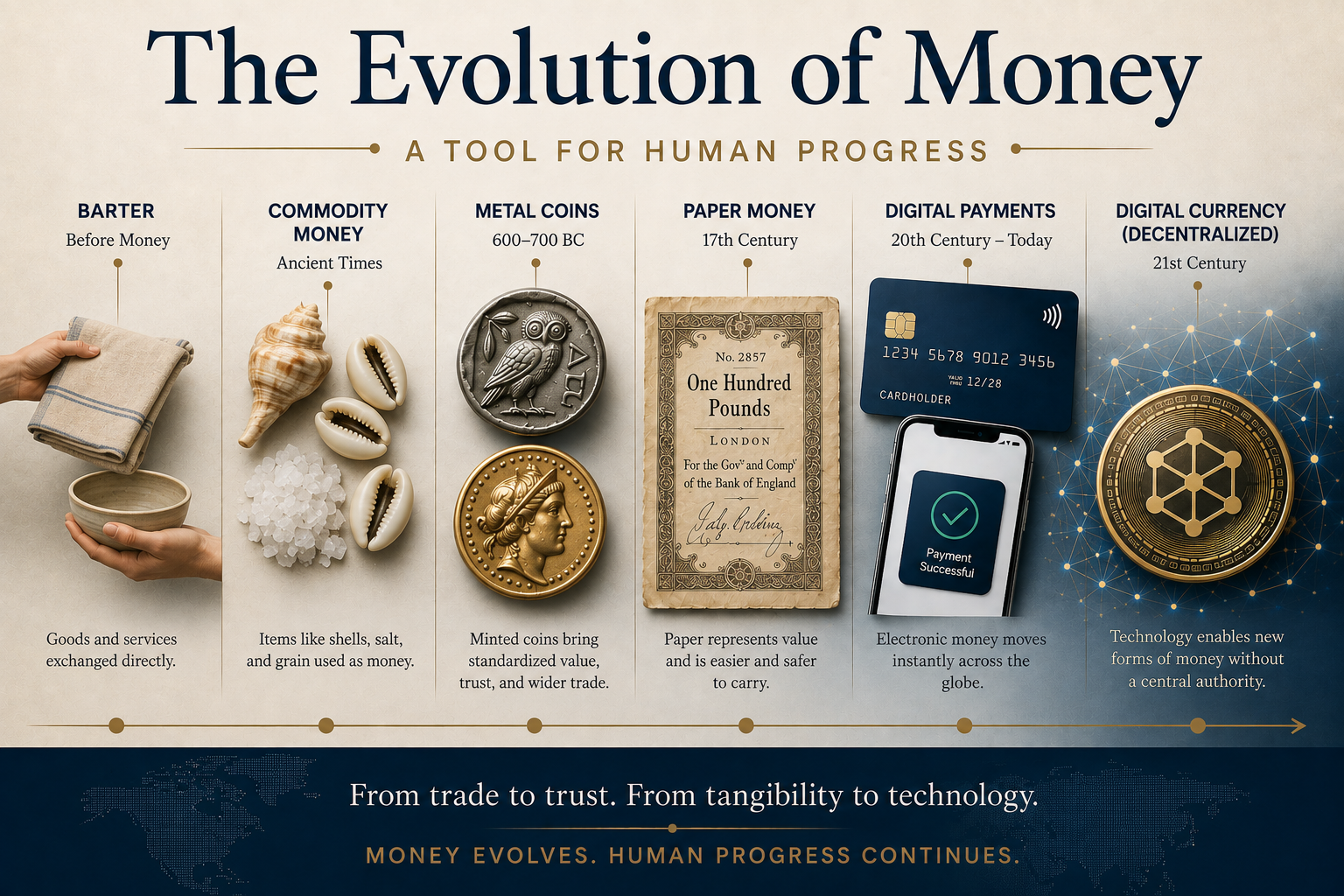
Long before coins, cash, or digital wallets, people relied on barter — trading goods and services directly. A farmer might trade grain for a blacksmith’s tools. A hunter might exchange meat for clothing. But barter had a fundamental flaw. It required a “double coincidence of wants,” meaning both parties had to want exactly what the other was offering at the same time. This made trade inefficient and severely limited economic growth and specialization.
Adam Smith and the Origin of Exchange
In The Wealth of Nations, Adam Smith observed something profound about human nature: “The propensity to truck, barter, and exchange one thing for another… is common to all men.” He also explained that exchange is driven by self-interest rather than charity: “It is not from the benevolence of the butcher, the brewer, or the baker that we expect our dinner, but from their regard to their own interest.” Human beings naturally create, specialize, and trade because it benefits them — and in doing so, they create value for others. Money simply emerged as the tool that made this natural behavior far more efficient.
The Birth of Money: A Better System
To solve the inefficiencies of barter, societies began using commonly accepted items as a medium of exchange. Early forms of money included shells, salt, livestock, and eventually precious metals. Over time, certain items proved more effective because they were durable, portable, divisible, scarce, and widely accepted. Gold and silver ultimately became dominant because they best satisfied these characteristics.
Coins and Governments: Standardizing Value
Around 600–700 BC, the first metal coins were minted in ancient Lydia. Coins brought structure to commerce by standardizing value, increasing trust, and accelerating trade. Governments soon began minting currency, reinforcing credibility while also introducing centralized control over money.
Paper Money: Trust Becomes Abstract
Carrying large amounts of gold was not practical, which led to the emergence of paper money — first in China, then across Europe. Initially, paper currency represented a direct claim on physical gold or silver. Over time, that link faded, giving rise to fiat currency, where money holds value primarily because people trust the system and institutions behind it.
The Modern System: Fiat and Central Banking
Today, money is largely digital and managed by central banks. Its value is supported by economic productivity, government stability, monetary policy, and public confidence. The system works not because money has inherent value, but because we collectively believe in it.
The Digital Evolution: Cryptocurrency
In 2009, Bitcoin introduced a decentralized, blockchain-based system for transferring digital assets without relying on a traditional central monetary authority. Since then, thousands of crypto assets with widely varying structures and characteristics have emerged. Their role in the financial system continues to evolve.
The Deeper Truth: Money Is a Tool
Across every stage of this evolution, one truth remains constant: money is not wealth. Wealth is the creation of goods and services that improve lives. John Tamny makes this point clearly in Money Confusion when he writes, “The getting is what happens after we’ve produced value for others.” Adam Smith captured the same idea centuries earlier: “The sole use of money is to circulate consumable goods.” Money itself does not feed, clothe, or shelter us — goods and services do. Money simply helps move those things efficiently through society. It allows us to store value, exchange value, and measure value, but it is never the end goal.
Why This Matters
Understanding the history of money reveals something much bigger than financial systems. Trade is a natural human behavior. Trust is the foundation of all money. Innovation continues to reshape how we exchange value. And most importantly, money is not the goal — it is the tool that allows human creativity, innovation, and production to flourish.
A Call to Action for Your Financial Future
As you think about your own financial plan, especially as you prepare for or navigate retirement, this perspective becomes highly practical. If wealth is created through production, then investing doesn’t have to be about predicting which individual companies will succeed or trying to time markets. Instead, it can be about participating in the long-term growth of human productivity in a disciplined and intentional way.
At FVIM, our approach is grounded in evidence-based investing: broad diversification, attention to costs, and a disciplined long-term perspective. That means building broadly diversified portfolios, keeping costs low, and remaining committed to a long-term strategy grounded in decades of academic research rather than short-term speculation. Instead of attempting to identify the next winner, we focus on capturing the returns generated by the global economy as a whole — millions of businesses, innovators, and producers working every day to create value.
When your portfolio broadly participates in that engine of production, the focus shifts away from trying to predict short-term market movements or reacting to market noise. Instead, you are participating in the same forces of innovation and economic activity that have contributed to progress and wealth creation throughout history.