

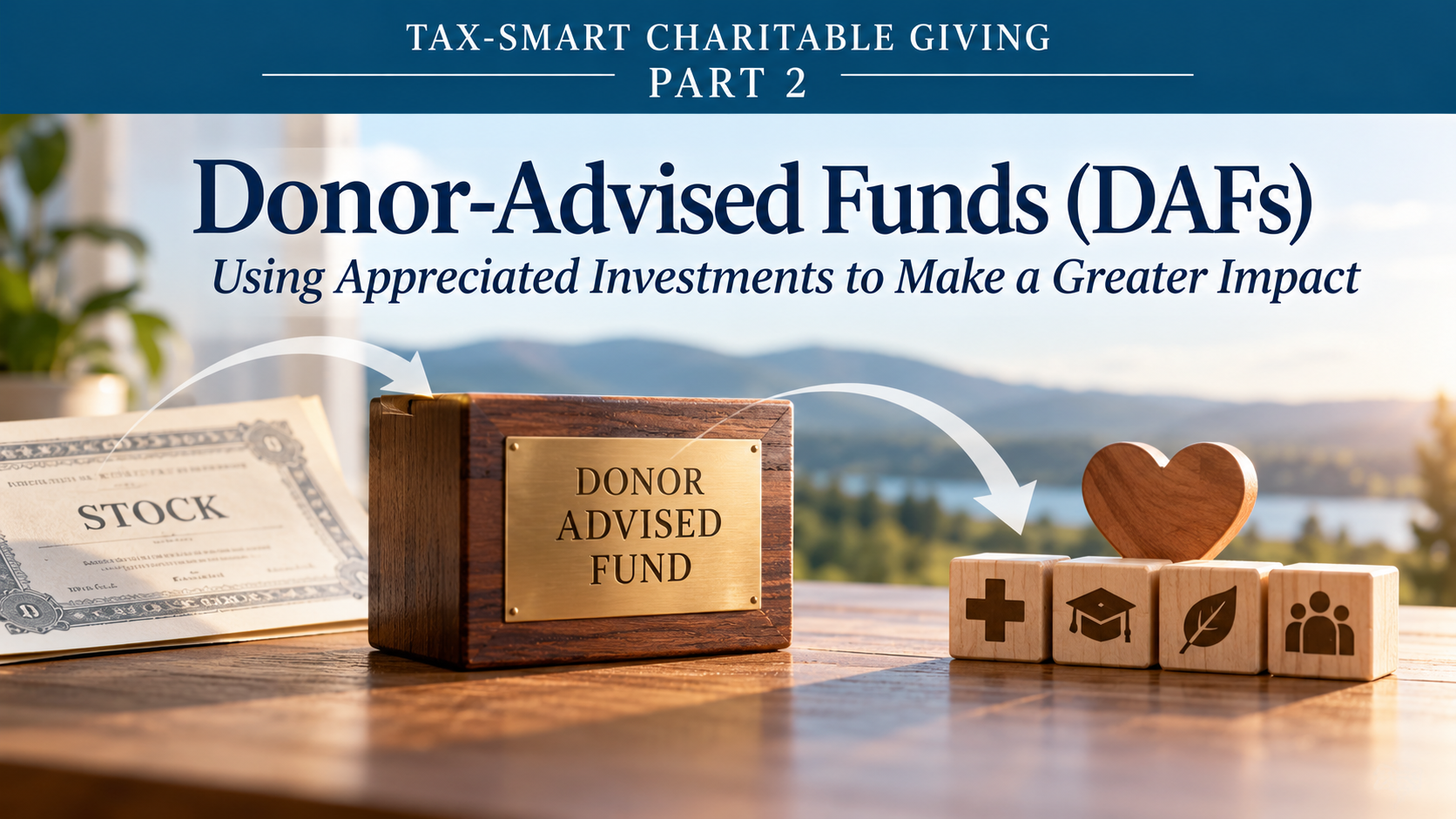
Give Now, Grant Later: Understanding Donor-Advised Funds
A donor-advised fund can separate the timing of your charitable deduction from the timing of grants to charities.
Following last month’s discussion of Qualified Charitable Distributions (QCDs), we continue exploring how charitable giving can do more than support the causes you care about. When coordinated with your investment portfolio, it may also create valuable tax-planning opportunities.
What Is a Donor-Advised Fund?
A donor-advised fund (DAF) is a charitable account maintained by a sponsoring public charity. One option we use with clients is DAFgiving360 (formerly Schwab Charitable). You contribute cash or investments, receive a potential tax deduction in the contribution year, and recommend grants to eligible charities over time. DAF contributions are irrevocable, and accounts may incur administrative and investment fees. The invested assets are subject to market fluctuations, but donors can generally select from a range of investment options.
For investors holding appreciated stock in taxable brokerage or trust accounts, a DAF can offer two valuable tax advantages. Unlike the Qualified Charitable Distributions discussed in Part 1, this strategy focuses on investments held outside retirement accounts.
Two Tax Advantages of Giving Appreciated Stock
1. Avoid recognizing capital gains. By donating qualifying stock held for more than one year directly to a DAF, you generally avoid realizing the gain that would have been taxable had you sold the shares yourself.
2. Receive a potential charitable deduction. If you itemize, you may qualify for a deduction based on the stock’s full fair market value—not just its appreciation—subject to applicable tax limitations.
Give the Stock. Reinvest the Cash.
Suppose you normally write a $10,000 check to your church. You also own stock worth $10,000 in your taxable brokerage account that you originally purchased for $4,000.
Instead of writing the check, you contribute the appreciated shares to your DAF and recommend a $10,000 grant to your church. You then invest the $10,000 cash you otherwise would have donated in your brokerage account, potentially repurchasing the same investment.
Your church receives the intended gift in the form of a check. You avoid recognizing the stock’s $6,000 embedded gain, and the newly purchased shares have a cost basis of approximately $10,000 instead of $4,000. If you itemize, the DAF contribution may also qualify for a charitable deduction based on the shares’ $10,000 fair market value, subject to applicable limitations.
| Before | After | |
|---|---|---|
Stock value | $10,000 | $10,000 |
Cost basis | $4,000 | ~$10,000 |
Unrealized gain | $6,000 | ~$0 |
For charitably inclined investors, this can be a practical way to reduce embedded gains and refresh cost basis without changing the amount given to charity.
Timing Your Charitable Deductions
A DAF also allows donors to “bunch” several years of planned charitable gifts into one tax year. A larger contribution may make itemizing more beneficial in that year, while grants to favorite charities can continue over time.
Bunching in practiceSuppose a couple normally gives $15,000 per year. Instead of making separate gifts each year, they might contribute several years of planned giving to a DAF in a single year, claim the allowable charitable deduction in that funding year, and then recommend grants from the DAF to their favorite charities over time. Whether this improves their tax result depends on their other deductions, income, contribution type, and applicable limits. |
Looking Beyond Today’s Tax Savings
A DAF can offer flexibility and significant tax-planning opportunities, but it is not necessarily the best source for every charitable gift. For retirees with required minimum distributions, a QCD may sometimes produce a better long-term outcome—even when a DAF offers greater current-year tax savings.
Coming next month: Part 3 compares QCDs and donor-advised funds through a broader lens: current tax savings, which assets are depleted, and what beneficiaries may ultimately inherit. |
Important: This material is for educational purposes only and is not intended as individualized tax, legal, or investment advice. Tax rules are complex and subject to change. Please consult your tax and financial professionals regarding your individual circumstances.