

Giving From Your IRA: Understanding Qualified Charitable Distributions
For charitably inclined retirees,
a QCD can turn an IRA distribution into a gift
while keeping that qualifying distribution out of taxable income.
Many retirees support churches, nonprofits, and other charitable organizations year after year. Once IRA distributions enter the picture, however, the account used to make those gifts can matter almost as much as the amount given.
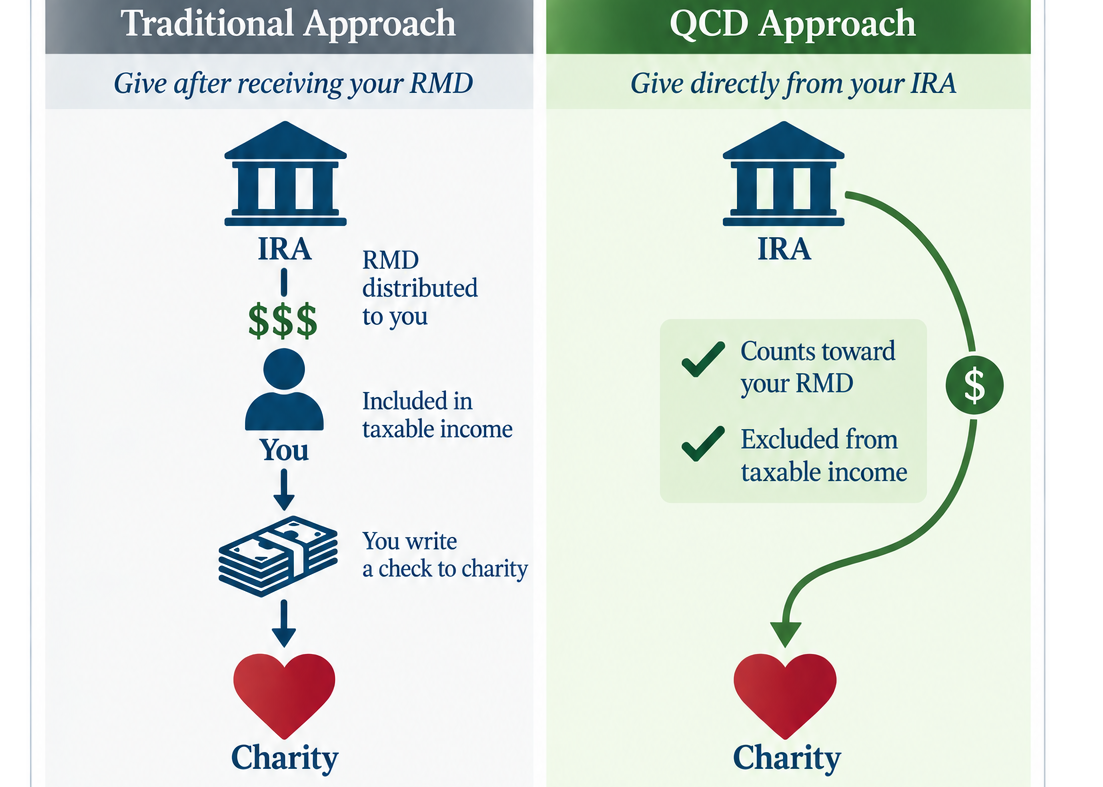
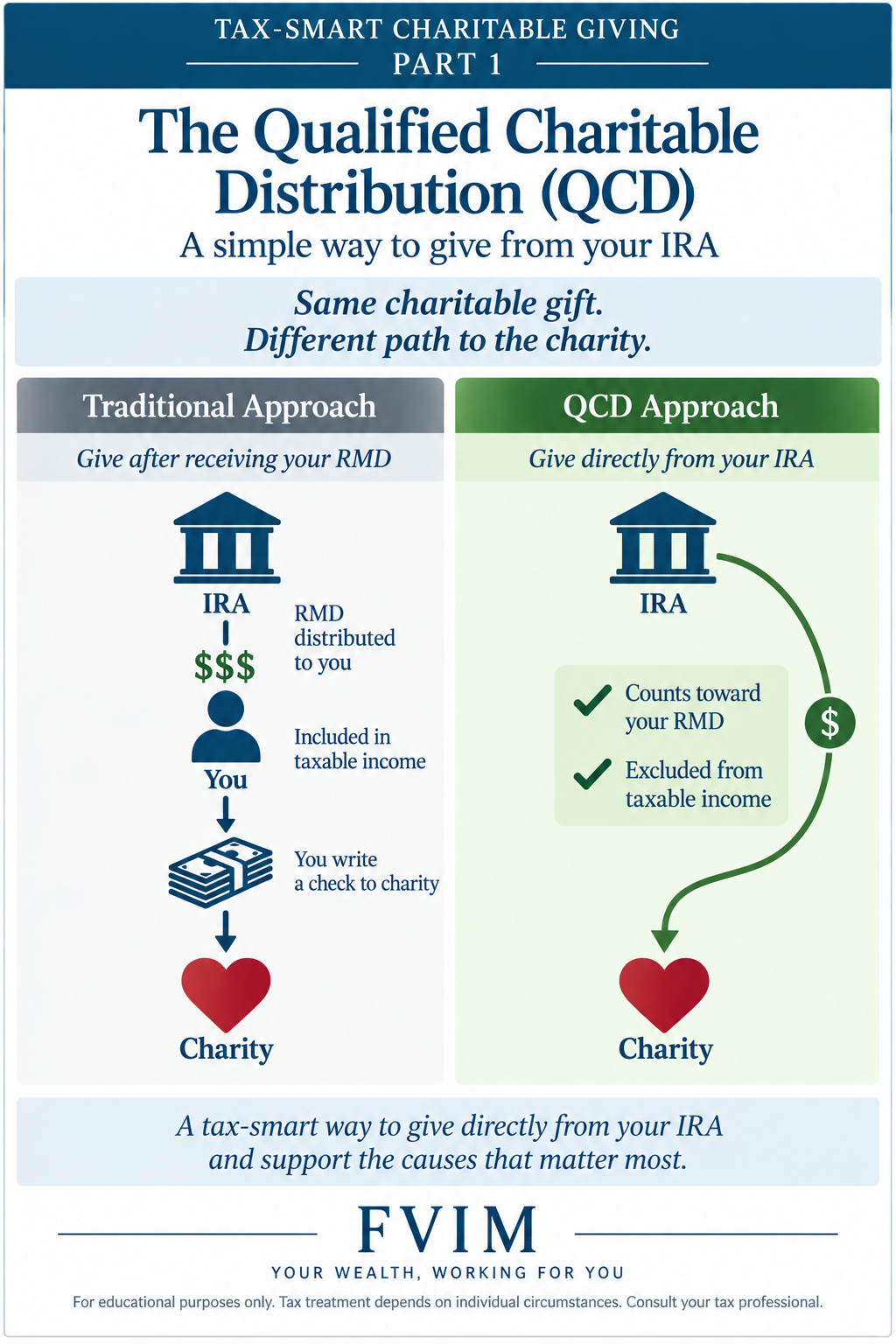
A Qualified Charitable Distribution, or QCD, is one way to give directly from an IRA. For the right taxpayer, it can satisfy charitable goals, count toward a required minimum distribution, and reduce the amount of IRA income reported on the tax return—all with one transaction.
What Is a QCD?
A QCD is a distribution made directly from an eligible IRA to an eligible charitable organization. The IRA owner must be at least age 70½ when the distribution is made. For 2026, the annual QCD exclusion limit is $111,000 per eligible individual.
If the requirements are met, the qualifying amount is excluded from taxable income rather than claimed as an itemized charitable deduction. That distinction is one of the features that makes QCDs especially useful in retirement.
How Does a QCD Work With an RMD?
Required minimum distributions generally begin later than QCD eligibility. Once a taxpayer is subject to RMDs, however, a QCD can count toward satisfying that year’s RMD.
Suppose your RMD is $40,000 and you normally give $10,000 to charity. If $10,000 is sent directly from your IRA to eligible charities as a QCD, that $10,000 can count toward the RMD while generally being excluded from taxable income. The remaining $30,000 of the RMD would still be distributed and taxed under the normal rules. |
Why Not Just Take the RMD and Write a Check?
Those two approaches can look economically similar—you receive money and a charity receives money—but they do not necessarily produce the same tax result.
With a QCD, the qualifying IRA distribution is excluded from income. If instead you receive the IRA distribution personally and then make a charitable gift, the IRA distribution is generally included in income. Any charitable deduction is governed by the separate rules for charitable contributions.
That difference can be meaningful for taxpayers who do not itemize. Beginning in 2026, non-itemizers may claim a limited deduction for certain cash gifts—up to $1,000 for single filers or $2,000 for married couples filing jointly—but that is very different from excluding a larger qualifying QCD from income.
Reducing Income Can Matter Beyond the Tax Bracket
The potential benefit of a QCD is not limited to multiplying the gift by a marginal tax rate. Because a qualifying QCD is excluded from income, it may also affect other tax calculations that depend on adjusted gross income. The exact impact varies by taxpayer and should be modeled rather than assumed.
Important QCD Rules
- The IRA owner must be at least age 70½ on the date of the distribution.
- The distribution generally must go directly from the IRA custodian to an eligible charitable organization.
- A QCD cannot be made to a donor-advised fund.
- A qualifying QCD can count toward an RMD for the year.
- You cannot also claim the same QCD as a charitable contribution deduction.
- The annual QCD limit is indexed for inflation; for 2026, it is $111,000 per eligible individual.
When Is a QCD Worth Considering?
A QCD may be particularly appealing when you are already charitably inclined, have IRA assets, are old enough to qualify, and either have RMDs or otherwise expect to take taxable IRA distributions. It can also be useful when you take the standard deduction and therefore receive limited benefit from itemized charitable deductions.
But a QCD is not automatically the best charitable strategy. If you have appreciated investments, want to front-load several years of giving, or want flexibility over when charities ultimately receive grants, another tool may deserve a closer look: the donor-advised fund.
Next Month: Part 2 explains how donor-advised funds work, why appreciated securities can be especially attractive gifts, and how “bunching” several years of charitable giving can create a larger deduction in one tax year. |
Important: This material is for educational purposes only and is not intended as individualized tax, legal, or investment advice. Tax rules are complex and subject to change. Please consult your tax and financial professionals regarding your individual circumstances.