


Conflict and Capital Markets: Why Discipline Wins
Conflict and Capital Markets: Why Discipline Wins
What nearly 100 years of market history tells us about investing through geopolitical crises.
Geopolitical conflict is a recurring feature of global history. In recent days, the Middle East has seen a significant escalation, with U.S. and Israeli strikes on Iranian targets followed by Iranian retaliation across the region. Markets have responded quickly—oil prices have moved sharply, volatility has increased, and uncertainty has dominated headlines. These events remind us how rapidly geopolitical developments can ripple through global financial markets.
Markets weigh these developments every second: volatility rises, uncertainty increases, and headlines amplify the tension.
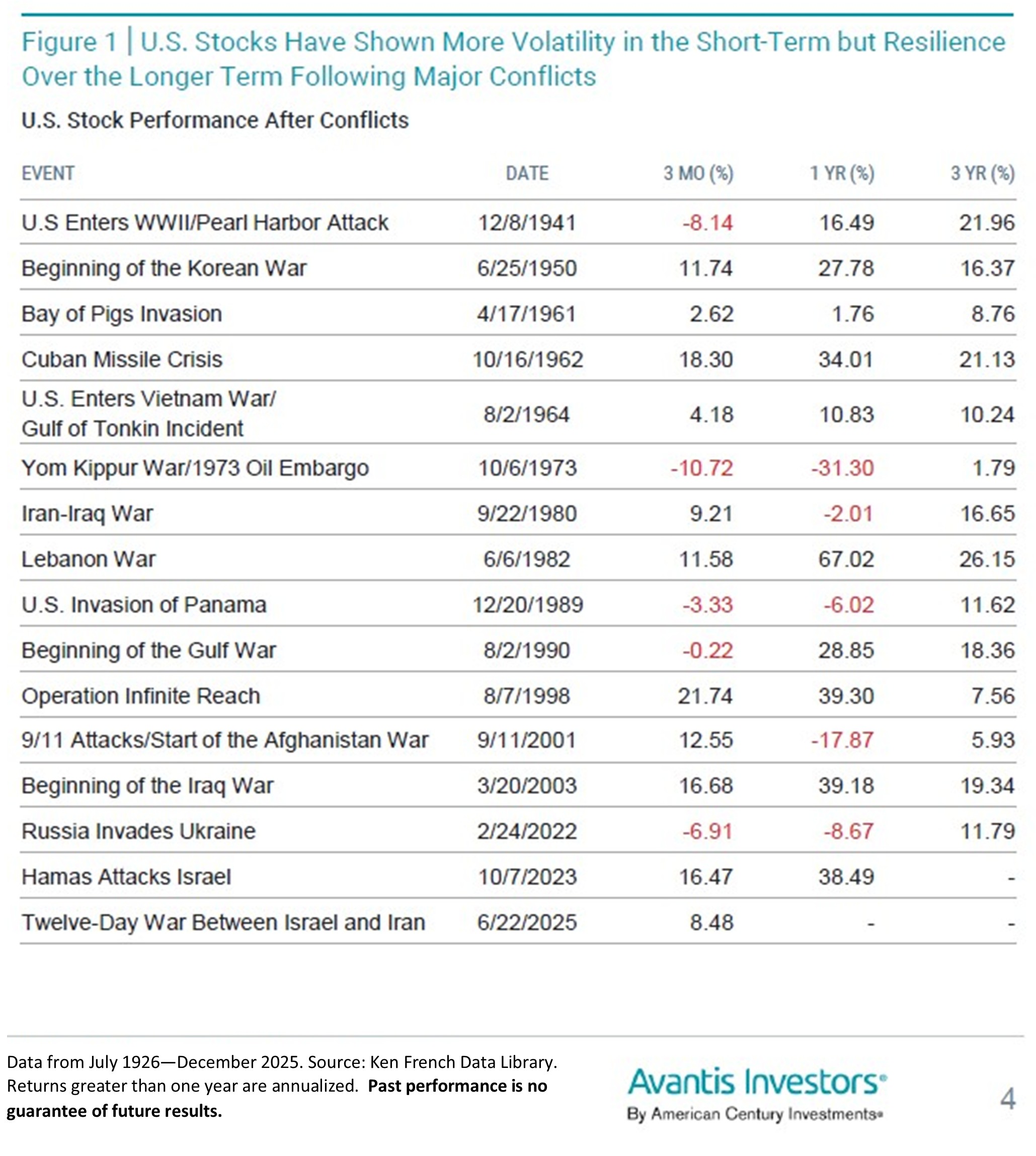
Investor Perspective: When geopolitical conflicts escalate, investors naturally worry about what it means for markets. Research examining nearly a century of market history shows that U.S. stocks produced positive returns in every three-year period following the start of the major military conflicts studied, with an average annualized return of roughly 13%.
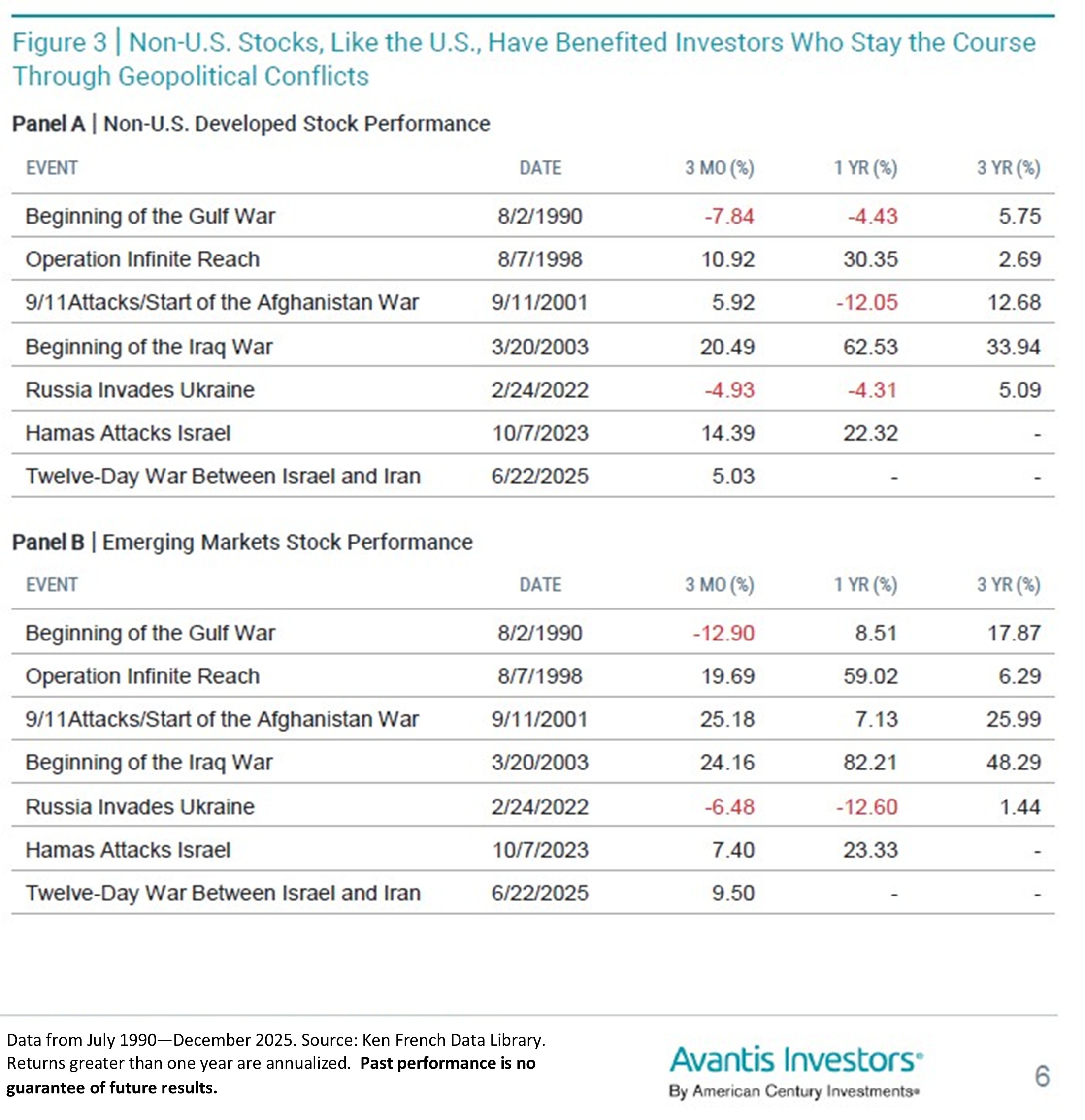
Importantly, international markets have shown similar resilience, reinforcing the case for globally diversified portfolios.
Moments like these often invite a broader perspective.
I was born in January 1976, and a simple question has stuck with me lately:
Has there ever been a time in my lifetime when there wasn’t a war or major conflict somewhere in the world?
The honest answer is no.
From the Cold War tensions of the late 1970s to the Gulf War, the post-9/11 conflicts in Afghanistan and Iraq, the war in Ukraine, and now renewed fighting involving Iran and Israel, conflict has been a recurring backdrop to global markets.
Yet through it all, economies adapt, innovate, and grow.
Over the past several decades, the global economy has expanded dramatically. Capital markets continuously absorb new information, price emerging risks, and often stabilize as uncertainty begins to fade.
What the Data Shows
History gives investors useful perspective.
Our friends at Avantis Investors recently analyzed nearly 100 years of market data examining how global stocks have performed following major geopolitical conflicts.
Short-term volatility is common as markets process new information. But declines are not inevitable, and positive returns have historically been more common than negative ones.
Over longer periods, the pattern becomes even clearer. Across the conflicts studied—from World War II through the war in Ukraine—every three-year period following these events produced positive returns for U.S. stocks, averaging roughly 13% annually.
The pattern is not limited to the United States. Avantis also examined developed and emerging international markets, which showed similar outcomes—short-term volatility but positive three-year returns following the conflicts studied.
For investors who believe in globally diversified portfolios, the evidence reinforces an important point: resilience in capital markets has historically been a global phenomenon, not just a U.S. one.
Geopolitical events can affect energy supplies, trade routes, and economic expectations. But markets are forward-looking systems. They rapidly incorporate new risks and then refocus on fundamentals such as earnings, productivity, innovation, and policy.
Key Takeaways for Investors
History suggests several consistent patterns when geopolitical conflicts emerge:
- Markets often experience short-term volatility
- Positive returns have historically been more common than negative ones
- Over longer periods, markets have shown strong resilience and recovery across both U.S. and international markets
The lesson: maintaining discipline during uncertainty has historically been more effective than reacting emotionally to headlines.
The Real Risk: Investor Emotion
Periods of geopolitical stress trigger powerful emotions—fear, urgency, and the instinct to act quickly.
But history suggests that allowing anxiety to drive major portfolio changes during global crises is rarely supported by the data.
Instead, disciplined investors focus on what they can control:
- Diversification
- Long-term asset allocation
- Systematic rebalancing
- Tax-smart portfolio management
- Avoiding emotional reactions to short-term news
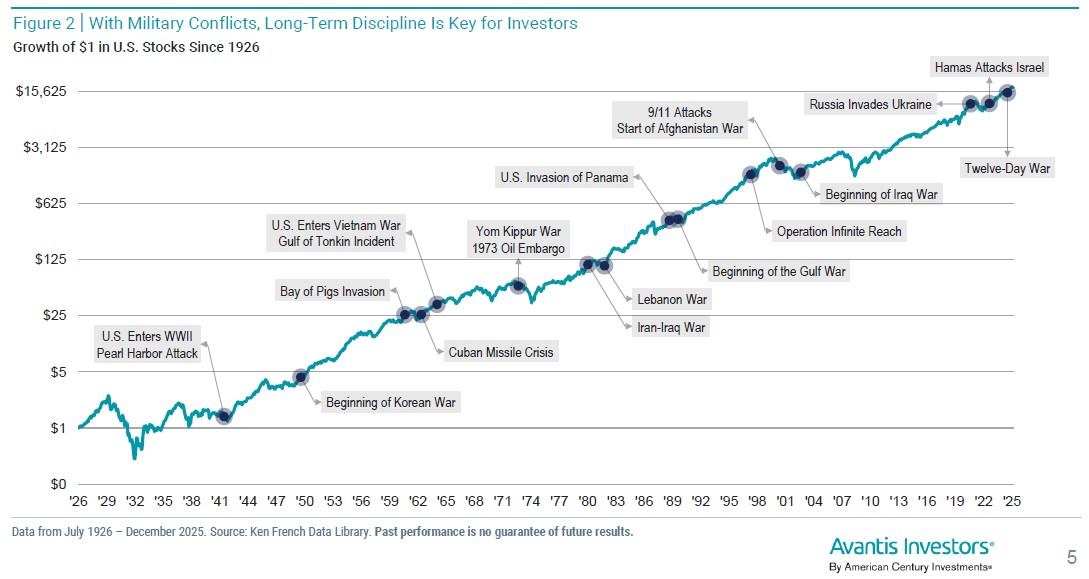
Markets have navigated wars, political upheaval, oil shocks, financial crises, and pandemics. Through each of these events, investors who remained patient and committed to a thoughtful plan were typically rewarded over time.
Staying Cool
When the world heats up—and it inevitably will—the most important response for investors is often the simplest one: stay disciplined.
Conflict is unpredictable, but markets are highly efficient processors of information. They absorb new risks quickly, adjust prices accordingly, and continue reflecting the long-term trajectory of economic progress.
Emotions are loud. Evidence is steady.
Staying cool doesn’t mean ignoring risks. It means refusing to let fear override a well-designed plan.
Economies adapt. Innovation continues. And patient investors remain positioned to benefit from the long game.
-- Matt Ebeling, Fort Vancouver Investment Management
Data source: Avantis Investors, “Military Conflicts and Global Stock Returns,” February 2026. Data from the Ken French Data Library covering July 1926–December 2025. See the full report here: Avantis_Miltary Conflicts and Markets.pdf